An hour nobody ordered
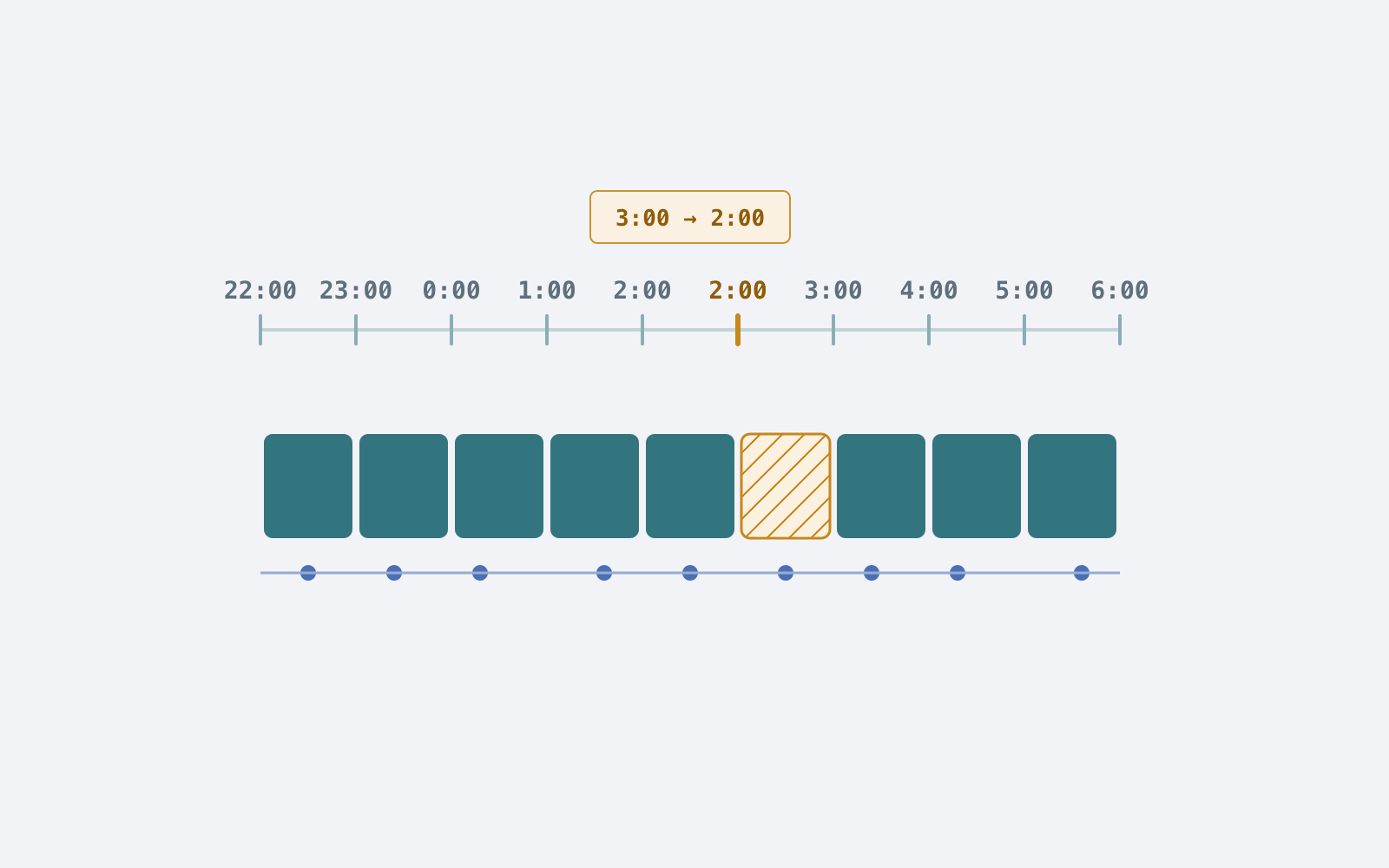
Anyone who plans tours assumes days of 24 hours. On two days a year that is wrong. In the last night of March the clock jumps from 2:00 to 3:00, and the night has 23 hours. In the last night of October it goes back from 3:00 to 2:00, and the night has 25. Both happen in the night from Saturday to Sunday.
Two nights out of 365. A little over half a percent. Statistically a corner case, and that is exactly how it is treated: most planning assumes a day of 24 hours, because on 363 days that is what it is.
For the people working that night, however, the hour is not statistical. It is there, or it is missing. And it falls in a night in which logistics runs differently from a weekday anyway.
Daylight saving is not an event. It is an assumption that fails twice a year.
The night belongs to the small vehicles
Trucks over 7.5 tonnes are banned from German roads on Sundays and public holidays from 0:00 to 22:00 (§ 30 StVO). The time change therefore always falls inside that ban. At 3:00 on Sunday morning, heavy long-haul traffic is parked at the rest area. Only the familiar exemptions are on the road: fresh milk, meat and fish, highly perishable fruit and vegetables, combined transport.
Everything below that limit drives. Vans under 7.5 tonnes know no Sunday ban. Night deliveries to pharmacies, branches and parcel depots, the early delivery of baked goods, the meal service delivering on Sunday morning: these flows pass through the switch twice every year. So daylight saving is not, in the first place, a long-haul topic. It is a topic of local logistics.
When the ban is suspended
Lately, even that no longer holds reliably. Because of low water on the Rhine, several German states relaxed the Sunday truck ban in the summer of 2026, so that goods could move from barge to road. North Rhine-Westphalia has just extended the suspension to December 20. There, heavy traffic rolls through this switch night as well.
What happens then? Nothing dramatic, as long as the hour is in the plan. The digital tachograph counts in UTC; driving and rest times are durations and stay what they are. Shift schedules, the slot at the loading dock and the promise to the recipient, on the other hand, are agreed on the wall clock. An hour the tachograph counts but no plan contains: that is exactly the problem.
Longer or shorter. And who pays?
A night shift from 22:00 to 6:00 lasts nine hours in October and seven in March. German labour law has no rule of its own for this. Collective and works agreements settle it, or nobody does. Then the questions arise only during the night: is the extra hour paid? Is it overtime? Is the missing hour made up? May the shift be nine hours long at all?
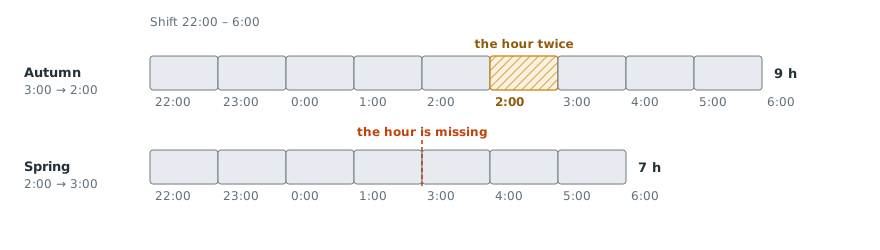
For tour planning it matters less how these questions are answered. What matters is that there is an answer. A shift has a start and an end. Both are on the wall clock. How much working time lies between them, planning only knows once it knows how long the night is.
The same goes for delivery deadlines. “Delivery by 6:00” is an hour more generous than usual in October and an hour tighter in March. Anyone who plans on Friday for Monday plans across the switch. As long as the planning thinks in clock times, that is harmless. If it calculates in intervals, everything on the far side shifts by an hour.
Wall clock or duration?
This brings us to the real question. A time in logistics means one of two things. Either a point on the wall clock: the dock opens at 6:00. Or a duration: no later than 90 minutes after loading. On 363 days a year the difference is invisible. On two nights it decides.
A delivery window is wall clock. The recipient has staff at the dock at 6:00, however long the night was. A shelf life is duration. Concrete sets, hot metal cools, blood and organs have a time outside the body, animals a permitted transport time. The material knows no daylight saving.
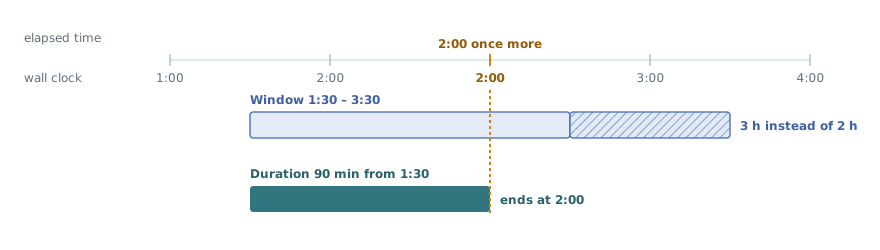
Anyone who keeps both in one column mixes them up in the switch night. A duration stored as a clock time becomes an hour too long in October and an hour too short in March. For parcels that is annoying. For organs, blood, animals or concrete, an hour more or less can decide the outcome. Put bluntly: daylight saving is the test of whether a system knows what it means by a time.
- Active ingredient
- one hour
- Dosage
- twice a year, at night, on a weekend
- Acts on
- shift ends, delivery windows, planning across the weekend, promises on the wall clock
- Does not act on
- driving and rest times, shelf lives, tachographs, anything counted in durations
- Interactions
- the Sunday truck ban and its suspension, deliveries across time zones
- Contraindication
- storing durations as clock times
The clock on the wall and the clock in the body
There is a third clock. Anyone delivering lunch on Sundays meets, on the day after the switch, people whose hunger has not switched. The body still runs on the old time. In October, twelve on the wall clock feels like one, and hunger arrives an hour early. In March it is the other way round.
So should the delivery follow the wall clock or the body clock? For planning, the answer is simple, even if it sounds unsatisfying: the wall clock. What was agreed is a clock time, and learned delivery times are clock times too. The body catches up with the wall within a few days. Planning that wanted to meet it halfway would have to know how fast each individual adjusts. It does not.
What decides is that this question is answered deliberately. Not by accident, through the way a system stores its times.
Across time zones
One consolation: in the EU, every clock jumps at the same instant, at 1:00 UTC. Lisbon, Berlin and Helsinki switch together, each to its own local time. A tour from Poland to Spain experiences the switch only once. The United Kingdom and Switzerland keep the same beat.
Beyond that it gets harder. The United States switches on a different weekend, this year on November 1. Turkey and Russia no longer switch at all. Between the two dates, the gap between Hanover and New York is five hours instead of six for a week. Anyone who agrees time windows across time zones therefore needs a common reference. In practice that is UTC. Local time is a view of it.
How we handle it in NUNAV
From all this, three rules follow for NUNAV. They sound unspectacular and make the difference on two nights a year.
- Calculate in absolute time, display in local time. Internally, every point in time is unambiguous, independent of time zone and switch. The wall clock is a view of it. So a night can have 25 hours without a tour losing or gaining one.
- Windows are windows, durations are durations. A delivery window is tied to the recipient's local time. A shelf life, a maximum travel time, a driving time is tied to duration. The two are kept apart and checked apart.
- Shifts have points in time, not lengths. A shift starts and ends on the wall clock. How much working time lies between follows from the night that actually comes. Whether that hour is overtime is not for the system to decide. But it shows it.
Before every switch, a look at the settings pays off: which shifts span the night? Which promises are windows, which are durations? Which plans reach across the weekend? Settle that on Friday, and Sunday brings a night like any other. Just an hour longer. Or shorter.
The decisive question
For daylight saving, it therefore matters less whether the calendar holds an hour more or less. The more important question is: does the planning know what it means by a time?