
Lower Saxony adopts policy-aware and load-balanced routing by Graphmasters
Hanover, Germany
HANNOVER, February 3, 2026 - The German federal state of Lower Saxony has commissioned Graphmasters to introduce a statewide policy-aware and load-balanced routing approach.
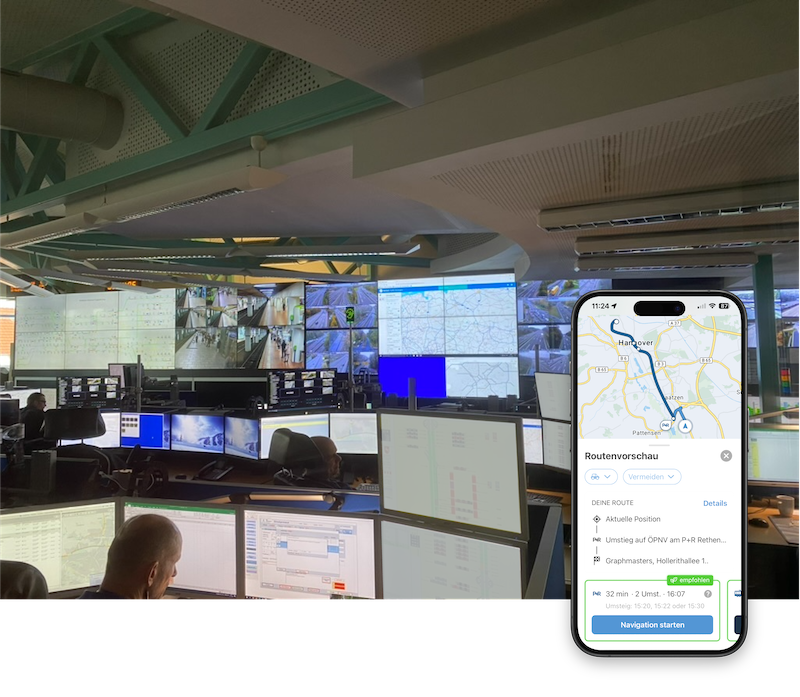
The objective is to move beyond purely individual travel-time optimization and systematically integrate transport policy, infrastructure-related, and organizational requirements into route guidance. The project is implemented in close cooperation with the Lower Saxony State Authority for Road Construction and Transport and the Traffic Management Center of Lower Saxony. It forms part of the state’s broader strategy for future-oriented, digital traffic management. A key milestone of the project is its practical relevance: Graphmasters' navigation software NUNAV already supports approximately eight percent of all car journeys. This represents the first large-scale, real-world deployment of policy-aware routing with meaningful market penetration. Traffic guidance is delivered directly in the vehicle, for example via Apple CarPlay or Android Auto, reaching road users precisely at the point where routing decisions are made. The Traffic Management Center of Lower Saxony defines concrete routing rules and objectives for major events, construction sites, or special traffic situations. These rules are maintained centrally, published in a standardized manner, and made available to all service providers through the national access point (NAP mobilithek.info) in line with legal transparency and data publication requirements. Routing decisions are implemented fully automatically. The Graphmasters routing technology combines published policies with real-time traffic data and collaborative feedback from users, allowing traffic to be distributed efficiently across the entire road network. By combining policy-based and collaborative routing, the system enables, for the first time, simultaneous and situation-dependent management of all traffic types, including commuter traffic, local and non-local trips, fleet operations, and event-related traffic. This is achieved in a data-driven manner without additional personnel requirements. The approach implemented in Lower Saxony is modular and transferable. Other federal states and regions can adopt the same framework without the need for fundamental redevelopment, making Lower Saxony a blueprint for policy-aware routing in Germany and beyond. In addition, the statewide implementation creates the conditions for consistently high data quality in accordance with European standards, such as the RTTI 5-star rating framework used by leading navigation and traffic information providers. Traditional navigation systems focus on individual route optimization. What they typically lack is the capability to balance traffic loads and to enforce binding, policy-driven routing rules. The Graphmasters approach bridges this gap by linking high-quality, publicly mandated traffic data with strategic traffic management and making it directly usable in vehicles.
Traffic Management Center Lower Saxony
Press release: Traffic management in Lower Saxony: Cooperation agreement for future-proof mobility
Mobilithek: Traffic strategies within the framework of Digital Traffic Management Lower Saxony (DVL-NI)
Intelligent Traffic Systems Act (IVSG)
NERZ E.V. blog article about publication obligations for municipalities and cities
Report in HAZ about the project
NUNAV Navigation in the App Store
NUNAV Navigation in the Google Play Store

More Articles
How NUNAV combines traffic forecasting and route coordination
Recommending a route changes traffic. Where NUNAV uses AI – and why every new route takes the trips already planned into account.
Continue reading
What research and traffic experiments show about collaborative routing
If everyone picks their individually best route, that does not yet add up to the best result for everyone. What research and the traffic experiment with the ADAC show – and what they don’t.
Continue reading
Residential streets, shortcuts and the question: who wants which traffic?
First, someone has to settle what “unwanted” traffic is. Why shortcuts can become a problem – and how NUNAV splits traffic up instead of sending everyone down the same residential street.
Continue reading