The problem is the order of events
The usual sequence is this: order volumes are fixed, the goods are picked, then planning starts. Planning therefore administers a result it no longer had any influence on. If the volume does not fit the fleet, only bad options remain – run an extra tour or leave goods behind.
Yet the volume is often not fixed at all. Anyone supplying their own stores decides for themselves what goes on the truck and when. Whether a store receives its replenishment today or tomorrow is a dispatch decision, not a customer commitment.
Plan first, then order
NUNAV Studio reverses the order. Planning runs before the order volume is fixed, and helps determine it.
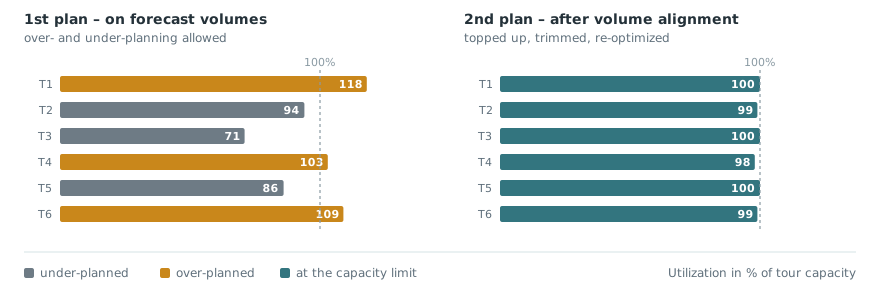
1. Plan on forecast volumes – over- and under-planning explicitly allowed
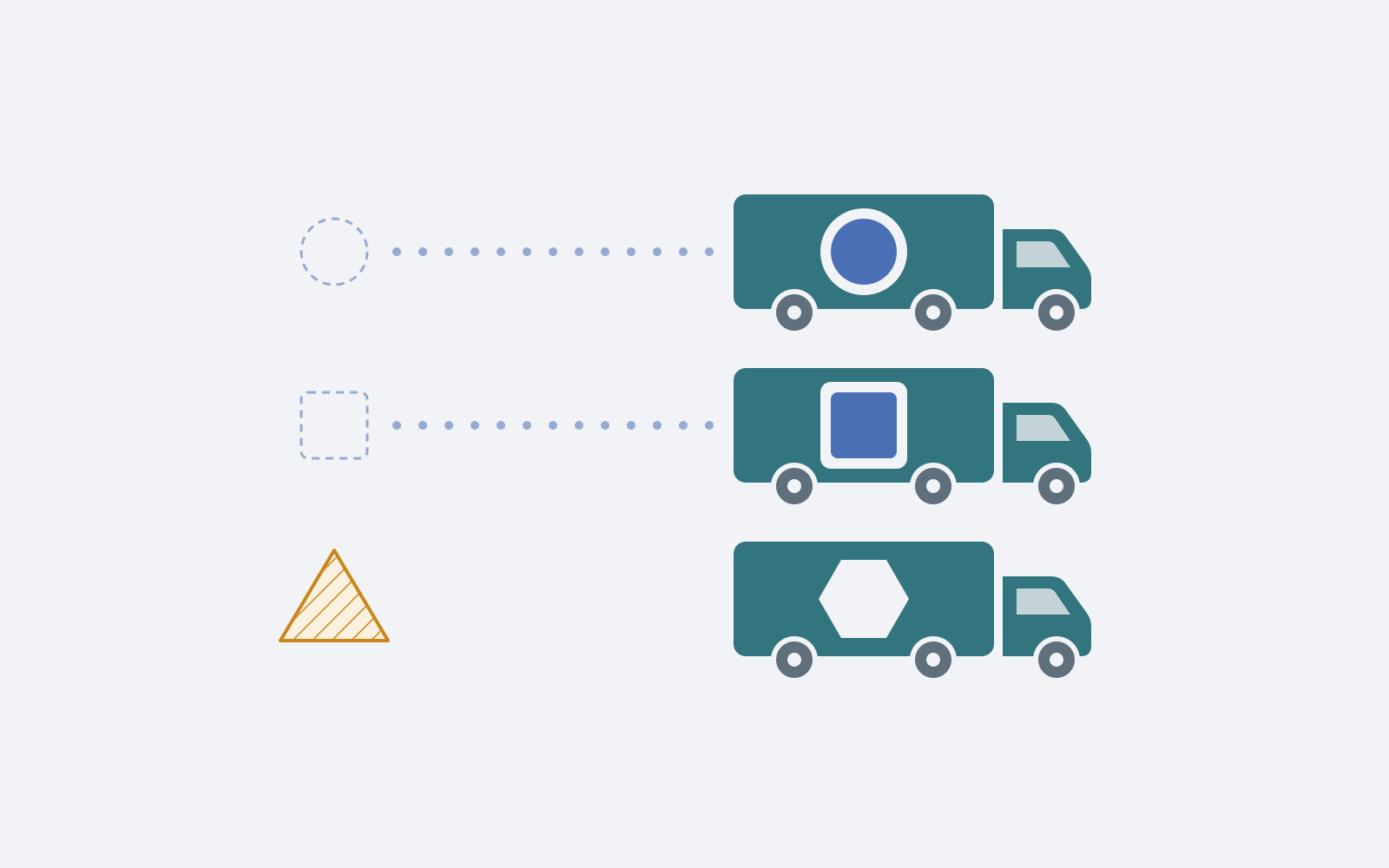
The merchandise management system supplies the expected volumes per store before the order is final. From these, Studio plans a complete set of tours and is deliberately allowed to miss the mark: some tours are too full, others too empty. A plan that already respected every capacity limit at this stage would be the wrong answer. It would hide exactly the potential that is meant to be unlocked.
2. Calculate the gap to the 100% mark
For each tour, Studio determines how much load is missing or surplus. Crucially, cargo space is not the only thing that counts. A tour can have room and still be full, because the driver's working time does not allow another unloading stop. Studio therefore caps the free space at what fits into the remaining shift – including the unloading time per box.
What is reported back is not a cargo-space figure but a reliable commitment: this tour can carry this much more.
3. Top up and trim
The differences go back into the merchandise management system. There, under-planned tours are topped up with replenishment that is due in the next few days anyway, and over-planned tours are trimmed by moving line items to the following day. Then the real orders arrive, overwrite the forecast, and Studio re-optimizes only the affected vehicles. The set of tours stays stable: nothing is re-planned, it is fine-tuned.
The prerequisite: you control the flow of goods yourself
The method works within your own network. Anyone delivering to third-party recipients with committed time windows cannot shift volumes – there, the order is a contract. Anyone supplying their own stores from their own warehouses, however, has exactly the freedom this needs: the volume is negotiable, the vehicle capacity is not.
What comes out of it
Instead of a set of tours with outliers above and below, you get one that sits tightly around the 100% mark. The savings do not come from shorter routes. They come from tours disappearing that were never needed, and from the remaining ones running through without a reload trip and without overtime.