Anyone who supplies a hospital does not plan one tour but many. They go to the same buildings, but they follow different rules.
Meals reach the wards two or three times a day. Sterile goods shuttle between the operating theatres and reprocessing. Facility and office supplies, medical products and dangerous goods come from the warehouse, pharmaceuticals from the pharmacy, some of them refrigerated at 2 to 8 °C. On top of that come lab samples, cytostatics, deliveries to medical practices and runs for the archive.
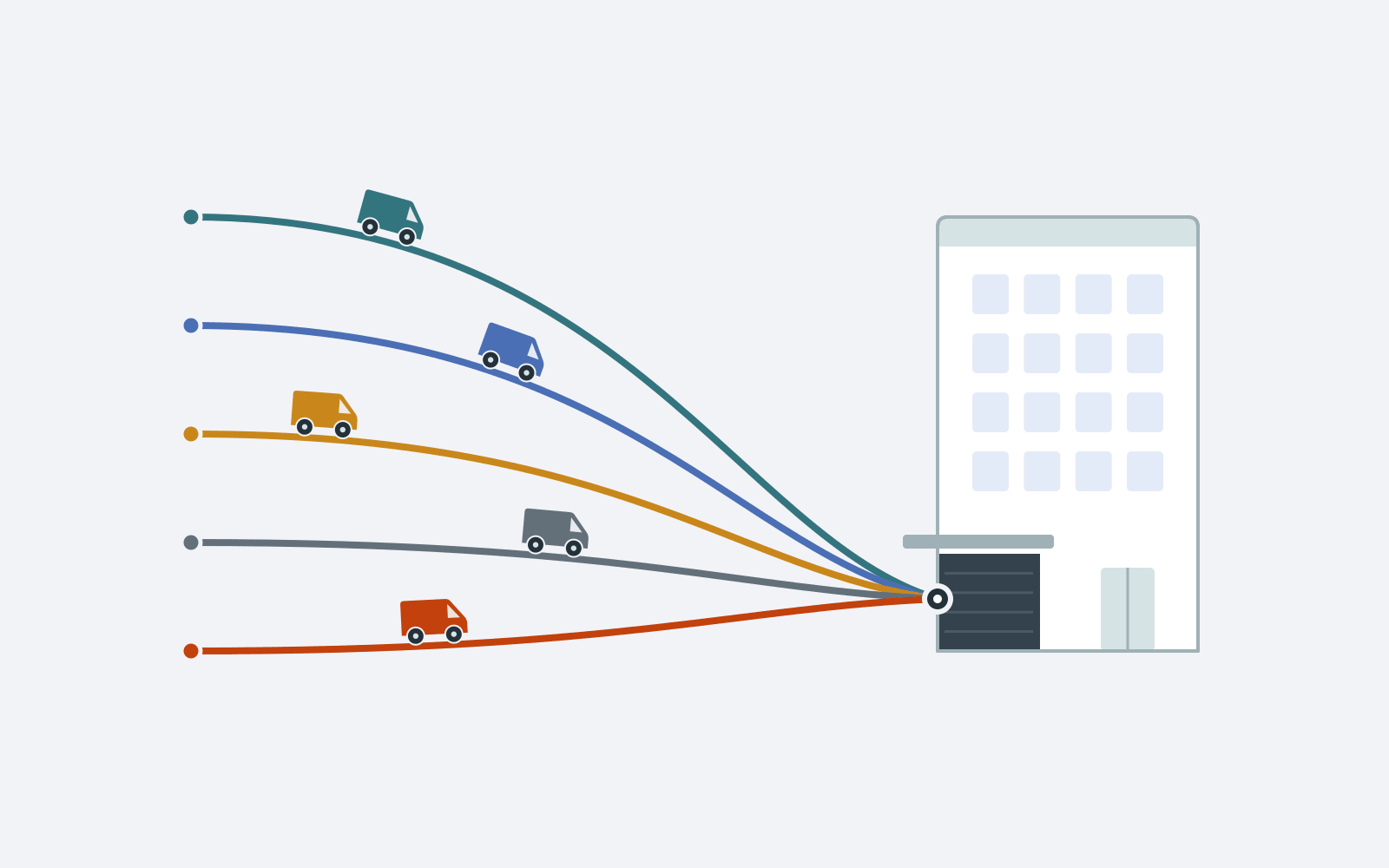
Each of these kinds of transport is well organised on its own. Together they make up a day on which the same building is served several times, often by different vehicles, sometimes a few minutes apart.
The timetable in the spreadsheet
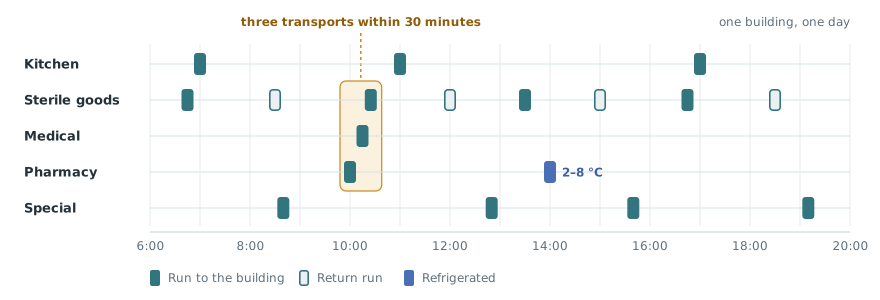
In many places this is planned in a spreadsheet. Internally it is often called the “bus timetable”, and the name fits: fixed departure times, fixed sequences, the same lines every day.
Such a timetable has its advantages. Anyone can read it, and it records what has proven itself over the years. It also has a limit. It describes when vehicles run. Why they run that way is not in it.
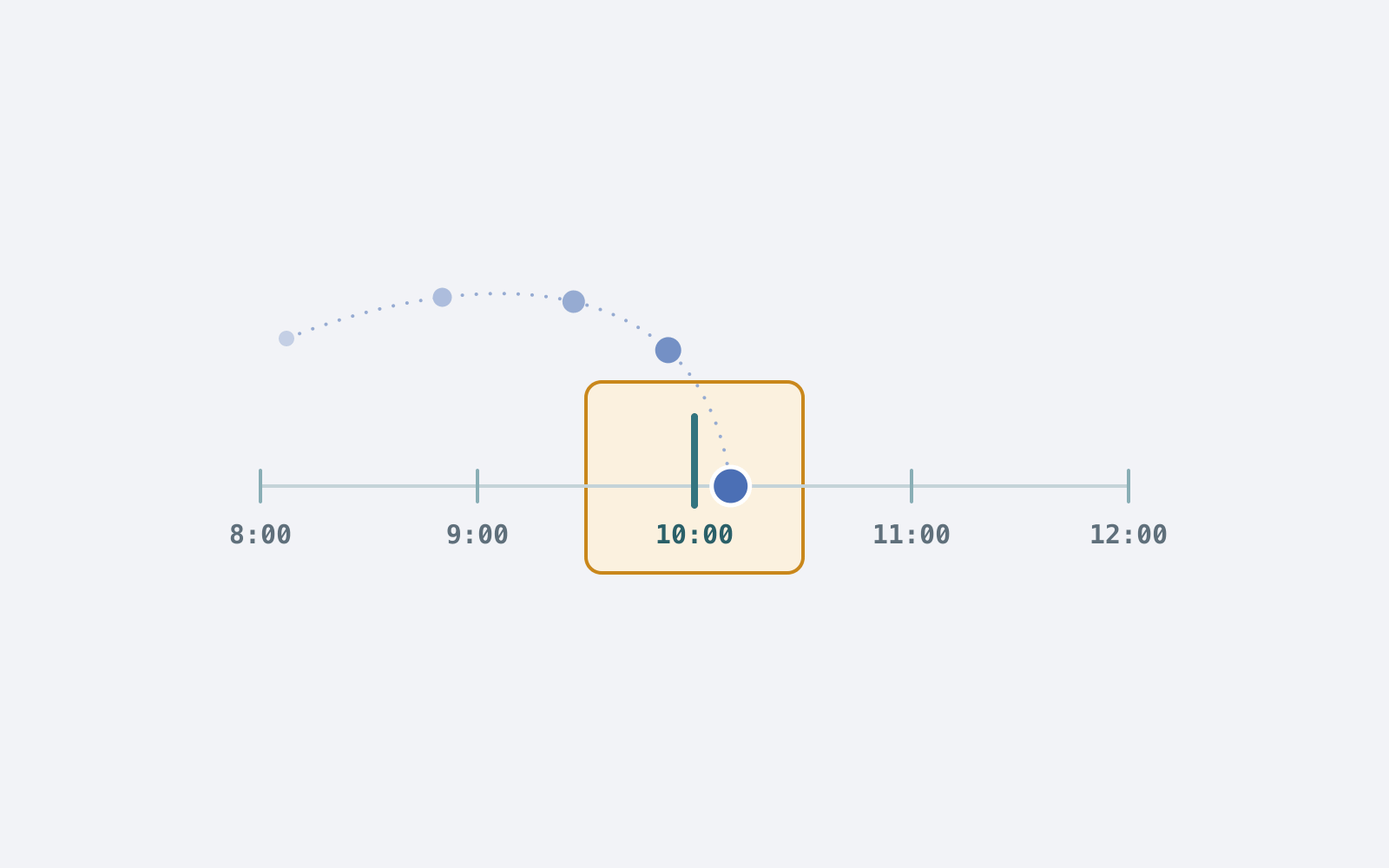
Whether the pharmacy run at ten could be combined with the medical run at a quarter past cannot be read from the spreadsheet. For that, one would have to know which vehicles may carry both loads, how much space they need and by when they have to arrive. That knowledge is usually not in the spreadsheet but in the heads of the dispatchers. As with learned delivery times, it first has to be made visible again.
A timetable describes when vehicles run. Planning also has to know why.
What may share a vehicle
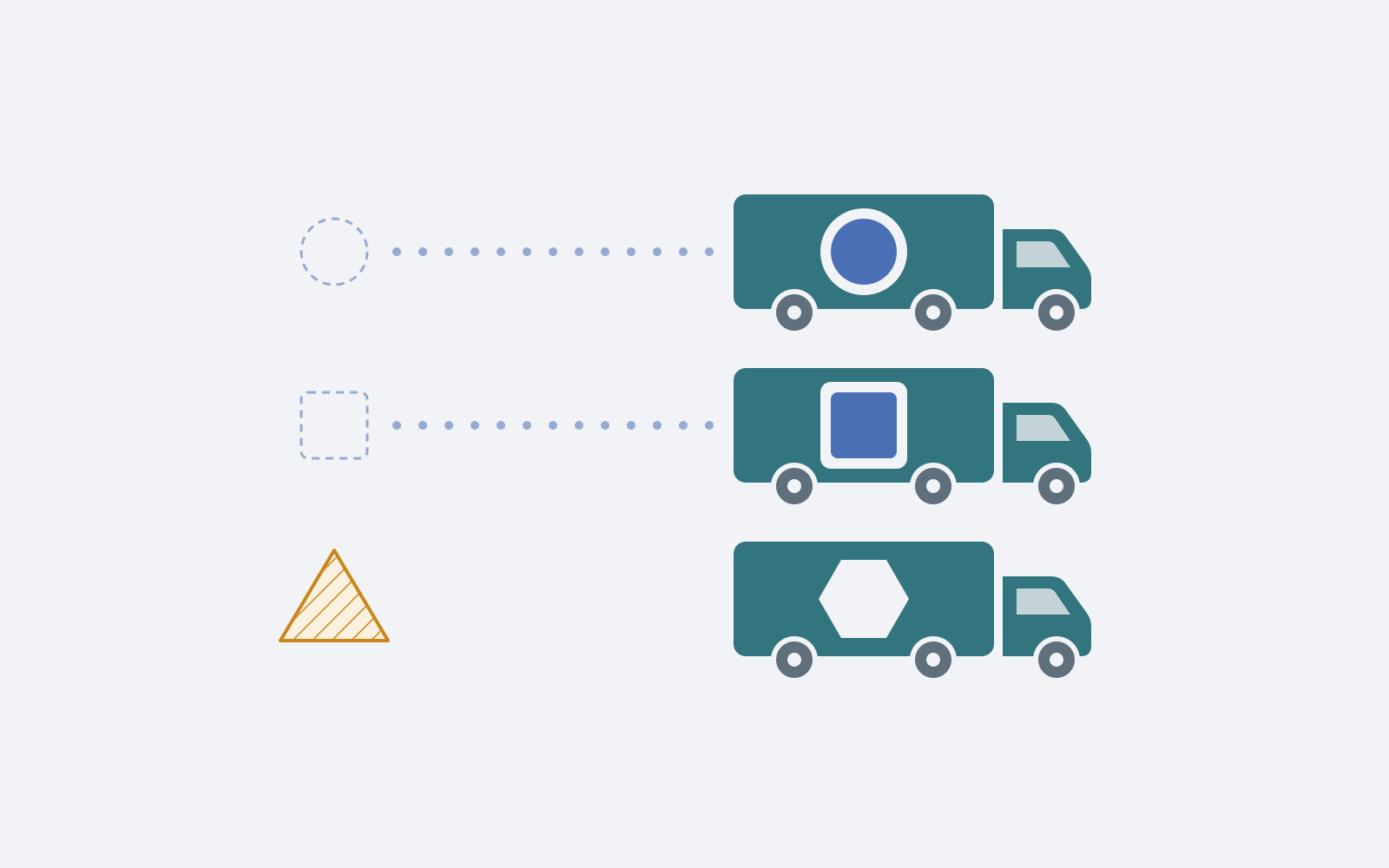
The obvious idea is bundling. If two transports go to the same building at a similar time, one vehicle may be enough. That saves kilometres, vehicles and working time.
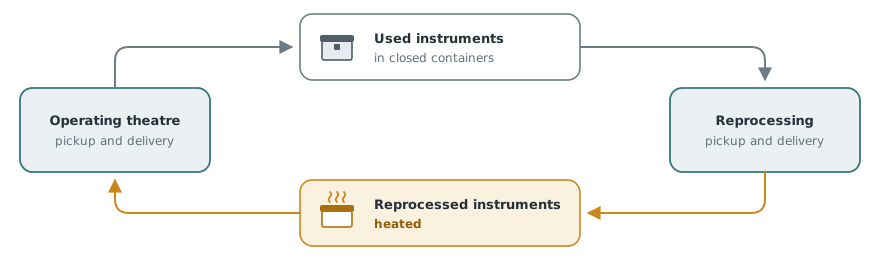
In hospital logistics, however, this idea is only as good as the rules that limit it. Used instruments travel closed and apart from reprocessed sterile goods. Sterile goods are often transported heated, because condensation can soak the packaging, and wet sterile packaging is no longer considered sterile. Pharmaceuticals need the right temperature range, dangerous goods a suitably equipped vehicle and trained staff. Meals have to be on the ward at serving time, not at some point in the morning.
- Kitchen
- fixed serving times, hygiene guidelines
- Sterile goods
- cycle between theatre and reprocessing, used and reprocessed kept apart, heated against condensation, hygiene-trained staff
- Medical
- facility and office supplies, ambient and dangerous goods, quality management to DIN EN ISO 13485
- Pharmacy
- pharmaceuticals at 2 to 8 °C or ambient, Good Distribution Practice (GDP)
- Special
- cytostatics and lab samples with transport rules of their own, medical practices, archive
Which transports may share a vehicle is therefore not, in the first place, a question of optimisation. It is a question of the rule set. Only once that is settled can the optimiser look for the best way to combine loads within it.
In NUNAV this rule set is stored as requirements and properties. An order asks for refrigeration or hygiene training, for example. A vehicle offers a heated or refrigerated load space, its drivers the matching training. Compartments in the vehicle each take only one kind of load. Only what fits together is planned. How that works in detail is described in the article Rules in tour planning.
Sterile goods also show that bundling does not only happen between kinds of transport. The sterile goods cycle is a pickup and a delivery at once: reprocessed instruments go to the theatre, used ones go back to reprocessing. In NUNAV, pickups and deliveries are therefore part of the same plan.
One control room for all transports
Once the plan is made, the actual day begins. For dispatch, other questions count then. Where is which vehicle? When does the next delivery reach the ward? And when is the vehicle back at the warehouse, so that the next load can be prepared?
That needs one view of all transports, not five lists. In NUNAV the vehicle positions from the driver app come together on one map. Every stop has an arrival forecast that is updated as traffic and the tour progress. The end of the tour at the depot is a planned point in time too, and it is recalculated along with the rest of the tour. How such forecasts come about and how certain they are is described in the article Arrival forecasts.
The control room also needs knowledge about the buildings themselves. Where is the delivery area? When is goods receiving staffed? Who is the contact, and is there a site plan? In NUNAV every location has such a profile, with opening and blocked times, access notes, contacts and file attachments. The knowledge then belongs to the location, not to the person who happens to know it.
For several sites, hospitals or clients, NUNAV separates the data by organisation, region and depot. Roles determine who plans, who dispatches and who has read-only access.
What the project adds
Hospital logistics brings requirements that go beyond planning and dispatch. Typical requests are an electronic proof of delivery signed off on arrival, temperature data from the refrigerated body, alerts on standstill with fixed escalation chains, access through which transport partners take on and bill their orders themselves, or checks of payer and cost centre for special trips.
Such requirements can be mapped in the project. NUNAV provides interfaces for this, through which orders, events and times are exchanged with the systems that are already in place or agreed together. We settle which of them are needed, and in what depth, based on the actual process. Which traces NUNAV records itself is described in the article Traceability in logistics.
The decisive question
For hospital logistics, it therefore matters less how many transports reach a building each day. The more important question is: does the planning see all of a building's transports together?
How we support you
The switch from a timetable to shared planning does not happen in one go. We accompany it in three steps:
- Taking stock: Which transports run today, when, with which vehicles, to which buildings? We analyse the existing timetable and the tours actually driven.
- Rule set: Together we decide which transports may share a vehicle, which requirements vehicles and staff have to meet, and which times are fixed.
- Operation: Planning, live map, forecasts and location knowledge come together in one system. Existing systems are connected through interfaces.