Almost three in ten are 55 or older
In the German occupational area “transport, logistics, protection and security”, 29.1 percent of qualified employees were 55 or older. This is shown by an analysis by the Kompetenzzentrum Fachkräftesicherung (KOFA), in German, for the period from July 2022 to June 2023. KOFA expects that up to 755,000 of these employees could leave the labour market within the next ten years.
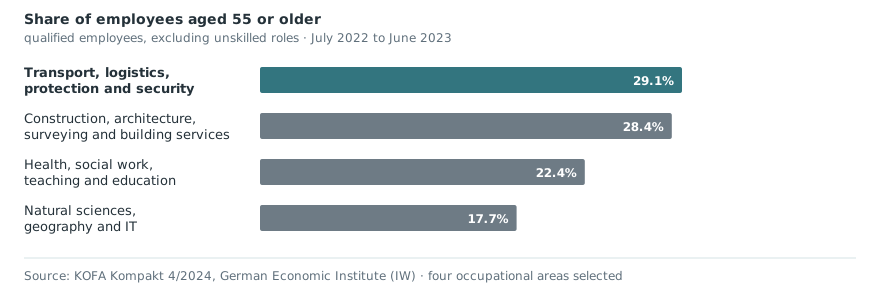
The figure describes the whole occupational area, including drivers, warehouse occupations and security services. The analysis does not report a separate value for dispatchers. For now, all that follows from it is that dispatch belongs to an area in which the share of older employees is particularly high.
What does that mean for companies?
What leaves with a person
Take transport dispatch. It is often staffed by people who have known for 20 or 30 years how the operation runs: which customer can be supplied when, which vehicle gets in where, which tour works and which one does not.
Little of that is recorded in any system. People simply know it. When they retire, this knowledge leaves with them, unless someone has captured it beforehand.
The loss does not show at first. The tours can still be driven. It shows only when something deviates from the usual and nobody remembers why things were set up that way.
Why do we always look for experience?
Anyone reading job advertisements for transport dispatchers finds almost the same requirements every time: professional experience, organisational talent, resilience, flexibility, commercial thinking and confident use of software. That is understandable.
But the requirement “professional experience” also says something about the company that asks for it. A company that presupposes this much experience often has no method for teaching new staff what it knows itself.
Yet what we call experience is often very concrete. It consists of information and relationships:
- Which delivery time windows work in practice?
- Which customers have special requirements?
- Which vehicle fits which order?
- What has to be considered in tour planning so that the tour can actually be driven?
A large part of what we call experience can be written down. It just rarely is.
What can be captured and what cannot
Experience is not all of one kind, though. To see what a planning system can take on, it helps to distinguish three parts.
- Rules: Some experience is a rule as soon as it is spoken aloud. This vehicle does not fit through the entrance, that goods-in desk is unstaffed at midday. In NUNAV Studio, such rules are stored as requirements of orders and as properties of vehicles and drivers. Planning then takes them into account for every tour, regardless of who is planning. More on this in the article on rules in tour planning.
- Habits: Other knowledge can no longer be named by anyone, because over the years it has dissolved into the procedures. When a delivery is expected is often written down nowhere. It can, however, be read from the tours actually driven. NUNAV derives learned delivery times from them.
- Judgement: A third part is neither rule nor pattern. Whether an exception is justifiable, and what takes priority in case of doubt, remains a decision for people.
The first two parts depend on individuals today, but would not have to. The third part should stay with people.
Planning under time pressure
Another classic in job advertisements is resilience under time pressure. Transport planning really is restless: orders arrive at short notice, vehicles break down, customers change their requirements.
It does not follow, however, that a person has to hold the entire plan in their head and find a solution under time pressure. A computer knows no stress and does not get tired. It can work through many planning variants in a short time.
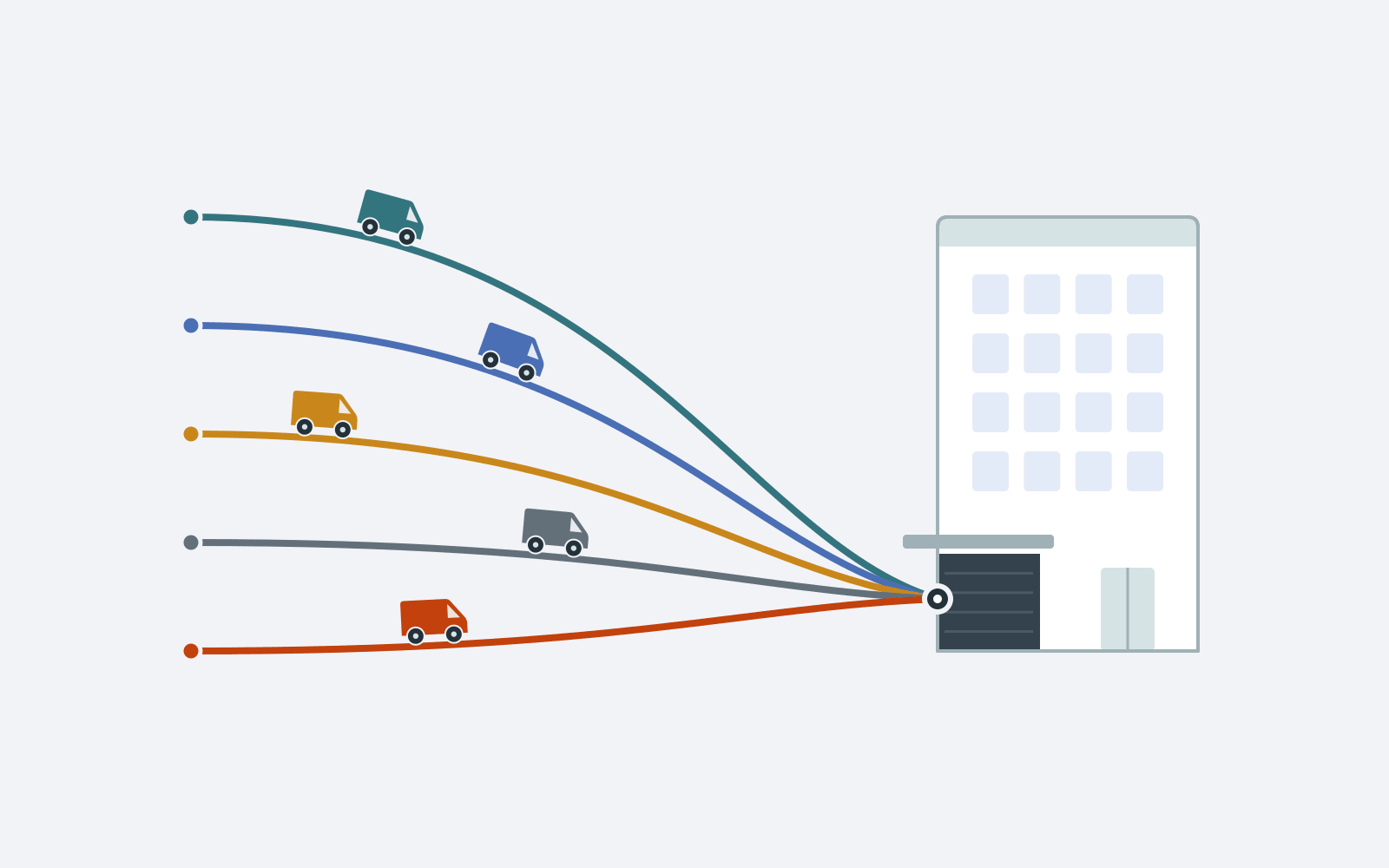
NUNAV Studio takes on this part. Tour planning takes the stored orders and planning conditions into account and computes tours from them. Dispatchers remain important. But they do not have to carry out every calculation themselves. They check the result, decide on exceptions and maintain the rules.
When the planning system builds up experience
It is not enough simply to reproduce the existing tours in software. A reproduced tour contains the result of experience, not yet the experience itself. Why is a particular customer always supplied in a particular way? Why does one tour work better in practice than another?
Here we have to distinguish between what is possible today and what we are working on. Today, rules can be stored, and delivery times and stop times are learned from the tours actually driven.
The next step goes further. AI-based methods open up the possibility of recognising recurring patterns in historical and current planning data that nobody has ever formulated as a rule. With NUNAV Studio, we are working on bringing digital transport planning and a company’s practical knowledge together in this way.
One distinction matters here: a recognised pattern is, for now, an observation. Whether it becomes a rule is for the company to decide. Not every habit is worth preserving.
The aim is a planning basis that is not set up just once, but can be developed further along with the company’s requirements and experience.
Not everyone has to know everything
We will not abolish the skills shortage with software. But software can do three things: relieve the existing staff, support new colleagues while they are being trained, and make sure that important planning information does not depend exclusively on individuals.
The point is expressly not to replace experienced dispatchers. Their experience is the source. We should use it while it is available and turn it into something the whole company benefits from in the long term.
The decisive question
For the next job advertisement, it therefore matters less how much experience a new dispatcher has to bring along. The more important question is: how much experience has our company itself already stored?
Good transport planning should not depend on the right person with the right knowledge always sitting at the right desk.