Most tour plans end in the evening. The truck does not. It stands at a truck stop, the driver takes the daily rest period, and the next morning the tour continues. How well Monday was planned therefore also decides whether Tuesday still works: when the driver may set off again, which traffic the truck then runs into, and whether it reaches the next customer within the delivery time window.
Whoever cuts the planning off at the end of the day only moves these questions to the next day, to a point at which many decisions can no longer be corrected.
TSP, VRP and the question of sequence
The classical foundations of route optimization are the Traveling Salesman Problem (TSP) and the Vehicle Routing Problem (VRP). They answer questions such as: Which stops are visited, and in which order? Which orders go to which vehicle? How can distance, driving time and cost be reduced?
Modern VRP methods do far more than sequencing. Time windows, capacities, breaks and many other constraints are standard today. The difference therefore does not lie in whether such rules are considered at all, but in how they depend on each other.
One example: many methods work with a fixed driving time per leg. In reality, the driving time depends on when the truck drives. The same leg can take an hour at 7 a.m. and forty minutes at 10 a.m. As soon as driving times depend on the time of day, every shift of a departure time becomes a decision with consequences for everything that follows. How we forecast such driving times is described in Arrival forecasts: when will the delivery really arrive?
Why a rest period is not an ordinary stop
In a tour plan, a rest period at first looks like a stop without a customer: a block of fixed length that is inserted somewhere. That picture is convenient, but it falls short.
A break or rest period depends on what happened before it: how long the driver has already been driving, when the last rest period ended, how many reduced rest periods have already been used this week. And it determines what is possible afterwards: when driving may resume, how much driving time is left, and which traffic situation the onward journey falls into.
Journeys, stops and rest periods therefore cannot be planned in isolation. They influence each other, and they do so across the end of the day.
An example: 10 p.m., truck stop
A driver starts the working day at 10 a.m. and parks the truck at a truck stop at 10 p.m. This is where the daily rest period begins. The next customer is a little under an hour away and accepts deliveries between 8 a.m. and noon.
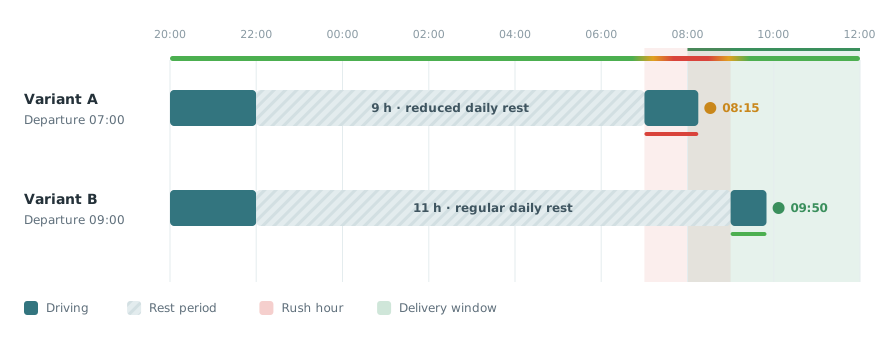
The obvious plan reads: nine hours of rest, departure at 7 a.m. Legally, that is permitted. It is not necessarily sensible. At 7 a.m. the truck drives into the morning rush hour, the journey takes longer, and the customer does not accept goods before 8 a.m. anyway. In addition, a daily rest period of nine hours counts as a reduced daily rest period. A driver may take at most three of those between two weekly rest periods.
The alternative: the driver rests until 9 a.m. That makes eleven consecutive hours of rest, a regular daily rest period. The truck drives after the rush hour, arrives within the time window, and all reduced rest periods remain available for the coming days.
Behind this lies a simple observation with considerable consequences. A rest period has a legally defined minimum duration. It does not follow that the driver has to set off the moment this minimum has passed. As long as the driver can freely dispose of their time and does not carry out any other work, the rest period can last longer. This changes not only the departure time, but possibly also the legal classification of the rest period.
For the optimizer, this means: under suitable conditions, the duration of a rest period is an optimization variable, not merely a rigid block of time.
It cannot be shifted at will, though. The daily rest period has to be taken within 24 hours of the end of the previous rest period. Had the working day in our example started earlier, the room for manoeuvre would be smaller. And every other departure time produces different driving times, possibly an additional break, and different arrival times at every customer that follows.
The legal framework: driving times, rest periods and tachographs
The rules are essentially laid down in Regulation (EC) No 561/2006:
- Article 4 defines the terms, including driving time, break and rest period.
- Article 6 limits driving time: as a rule nine hours a day, ten hours twice a week, at most 56 hours a week and 90 hours in any two consecutive weeks.
- Article 7 requires a break of at least 45 minutes after no more than four and a half hours of driving. It may be split into 15 minutes followed by 30 minutes.
- Article 8 governs daily and weekly rest periods: eleven hours as the regular daily rest, reducible to nine hours under certain conditions or split into three plus nine hours; in addition weekly rest periods, any reduction of which has to be compensated later.
The distinction between a break and a rest period matters. A break interrupts the driving time within a working day. A daily rest period ends it. In everyday language both are often called a "pause", yet they follow different rules.
The activities are recorded by the digital tachograph. Article 34 of Regulation (EU) No 165/2014 requires drivers to record driving time, other work, availability, and breaks and rest periods. The technical requirements for the smart tachograph are laid down in Annex IC of Implementing Regulation (EU) 2016/799. For the interpretation in roadside checks, the European Commission has published the TRACE II enforcement guidance (PDF).
What the tachograph does, and what it does not
The tachograph documents a sequence of activities over time. It describes the past. For planning, that is indispensable: how much driving time has already been used this week and when the last rest period ended is on the driver card.
At the same time, driving time, other work, availability, break and rest period are not the same thing. A truck that is standing still does not automatically mean that the driver is taking a rest period that counts. Someone who waits at the loading dock and has to be ready to unload at any moment is not necessarily resting within the meaning of the regulation. Conversely, reaching the minimum rest period does not automatically start a new driving or working phase. What decides is the actual activity and whether the legal conditions are met.
Put simply: the digital tachograph documents what a driver has done. A route optimizer, by contrast, has to calculate in advance what the driver may do in future, and when it makes sense to drive on.
The legal rules define which sequences are permissible. The optimization has to find the best possible one among the many permissible sequences. That is the decisive difference between a mere route calculation and a comprehensive, time-dependent multi-day optimization.
NUNAV Studio's approach
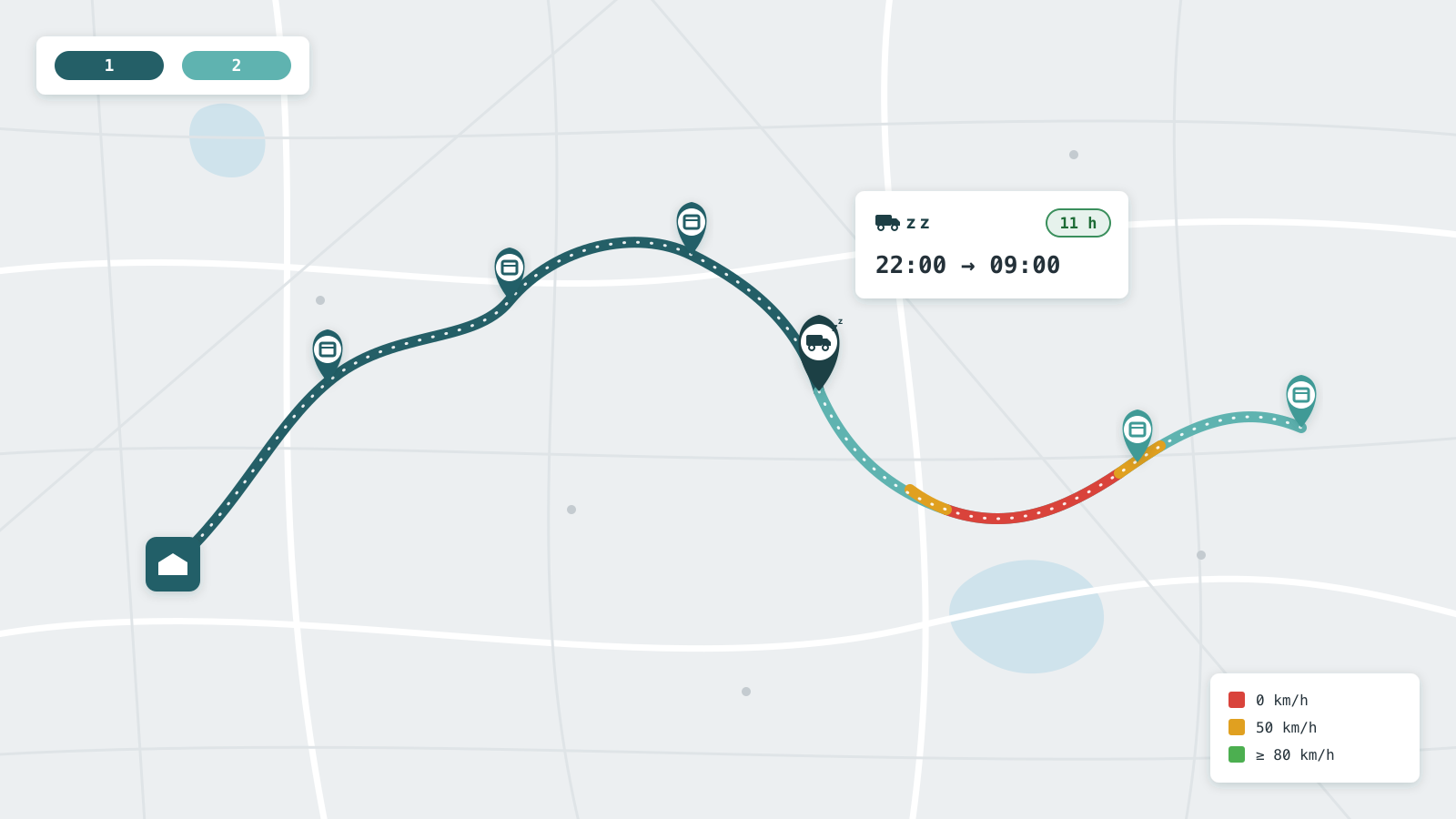
NUNAV Studio plans tours with time-dependent driving times. Traffic and traffic forecasts flow directly into the calculation: the driving time of a leg depends on when the truck drives it.
For multi-day truck tours, NUNAV Studio considers journeys, stops, delivery time windows and rest periods together rather than one after another. A rest period is therefore not inserted into a finished plan afterwards; it is part of the optimization. Its timing and, where permissible, its duration are chosen so that the sequence stays permissible across all days and becomes as good as possible. Which other rules feed into planning is shown in Rules in tour planning: what may travel together.
The question changes
Classical route optimization asks: which customer do we serve next? For multi-day truck tours, that question is not enough. The more important question is: when does it make sense to drive on?